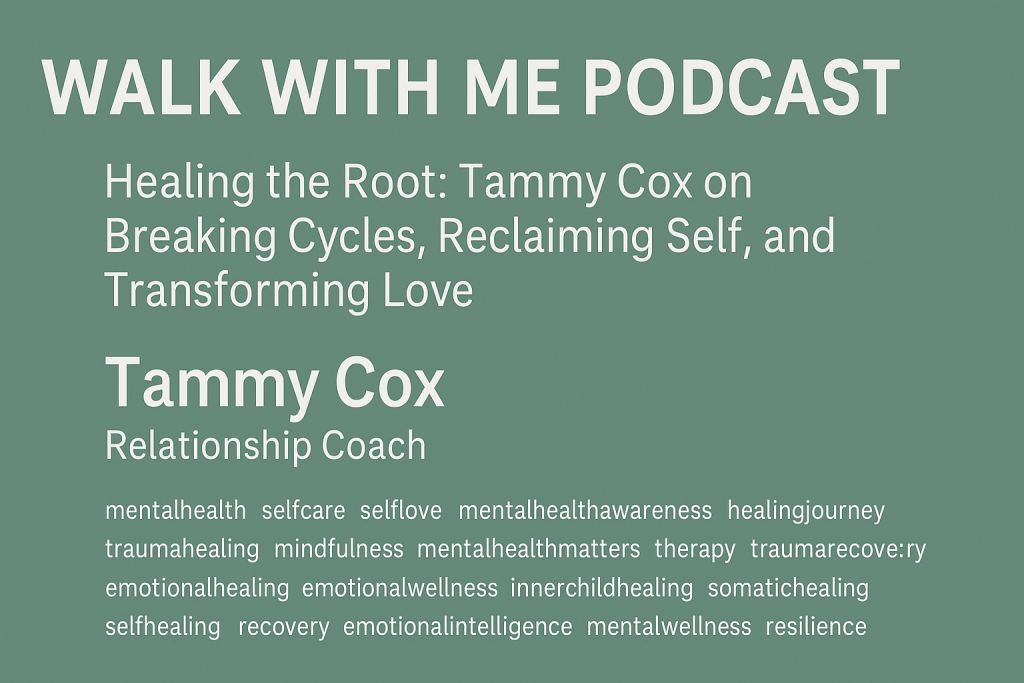
When I sat down with Tammy Cox, I wasn’t expecting the conversation to shift something inside me. Not because her story was unusually tragic—we’ve all heard stories of painful childhoods and hard-earned healing—but because of how rigorously honest she was about her process.
Tammy doesn’t market healing as a quick fix. She names what most of us would rather avoid: you can read every book, attend every seminar, recite every affirmation—and still carry the imprint of being unloved, unsafe, and unseen if you haven’t faced the root.
Her root was forged early. A childhood under religious control. A father who was emotionally and physically abusive. A home where thinking for yourself was punished. And then, the day everything shifted: her father’s death from AIDS when she was just eleven. She described the cocktail of relief, guilt, anger, and confusion that followed with a clarity that only someone who has excavated those emotions can access.
What stood out wasn’t just her pain, but her precision in describing the mechanics of trauma—how it embeds itself in the body, how it distorts our perception of love, and how it breeds a cycle of reactivity we often pass to our children without realizing it.
As a coach, Tammy helps women who are either searching for love or clinging to relationships that mirror their early wounds. And she’s unapologetic about what healing actually requires: not surface-level support, but someone willing to walk with you through the discomfort and back to the original wound. Not to re-traumatize, but to dislodge what’s been dictating your life beneath the surface.
Her clients often come to her on the brink—marriages barely holding together, self-worth in tatters. But Tammy’s approach isn’t to fix the marriage. It’s to locate the subconscious belief formed in childhood that made dysfunction feel like home. For her, it was the belief: I am unlovable. And until she confronted that, every relationship was shaped by its distortion.
This is not abstract theory. It’s embodied wisdom. And it reshaped how I think about transformation.
Tammy’s own motherhood journey became the crucible for change. Realizing that her unresolved pain was surfacing in her parenting—rigidity, reactivity, and inherited control—she made a deliberate decision: “If I don’t heal me, she is going to become me.” That was the inflection point. Not a dramatic revelation, but a gradual dismantling of inherited beliefs, normalized violence, and spiritual fear masquerading as love.
Leaving religion wasn’t about abandoning faith. It was about leaving fear. What she kept was the essence—compassion, presence, grace. And through that lens, she re-parented not just her daughters, but her own inner child.
Tammy’s work now extends far beyond her personal story. Through her podcast Behind the Veil and her coaching practice, she guides others through their own unmasking. She helps people find the belief behind the pain and replace it—not with a new narrative, but with a new way of being. One rooted in truth, not reaction.
What I know is this: Healing is not a linear process. It’s not clean. But it’s essential. And it demands more than knowledge—it demands presence. The courage to sit with yourself when you’re triggered. The discipline to trace your reactions back to their origins. The humility to stop blaming others for pain you haven’t yet claimed as your own.
Tammy reminded me that if we want to change the way we live, love, and lead—especially in a world pulsing with anxiety and disconnection—we can’t avoid the early wounds. We have to face them, with honesty and support.
And when we do, it doesn’t just stop the cycle of trauma. It births a new lineage—one rooted not in fear, but in freedom.