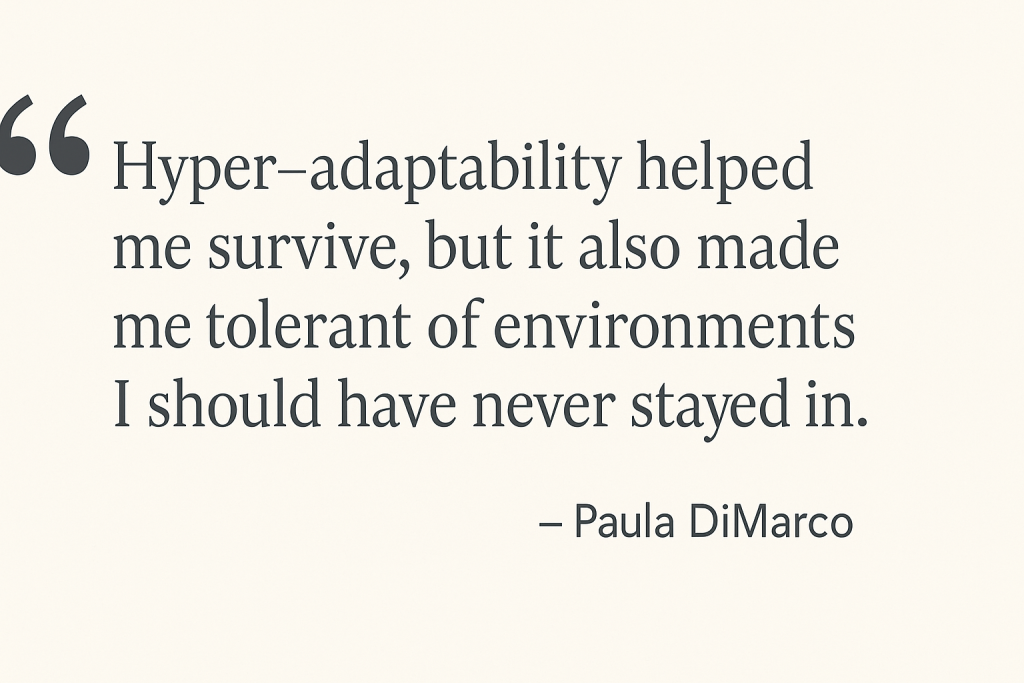
In my conversation with Paula DiMarco, I witnessed not only the trauma of loving someone who struggles with PTSD and depression, but also the silent, suffocating burden carried by those left behind when suicide is threatened—or worse, completed.
Paula’s story begins in resilience. Raised in a chaotic home, she learned early how to navigate dysfunction and instability, skills that—ironically—made her well-equipped to survive yet another storm. When she met Alex, a veteran battling inner demons, she recognized both sweetness and sadness in him. Like many empaths, she saw his pain and tried to love him through it. And like too many of us, she found herself in a position where love wasn’t enough.
Here’s what we must begin to say out loud: Being the one someone threatens suicide to is a trauma all its own.
When Alex told Paula, “I am going to kill myself tomorrow,” she stayed. She didn’t just stay—she entered what she described as “suicide watch,” trying to hold her world together with no institutional support, no roadmap, no backup. She called counselors, family members, and even law enforcement. The system did not respond.
And then, he was gone.
In the wake of that loss, Paula did what many trauma survivors do: she tried to find a place to set the pain down. She turned to writing, to painting, to anything that would keep her tethered to herself. But one of the most heartbreaking truths she shared was this: “I didn’t even feel I had the right to mourn. I wasn’t sure who I was mourning anymore.”
This is the unspoken grief of suicide loss. It’s not just death—it’s the death of a dream, a future, a shared identity. It’s confusion, betrayal, love, rage, and sometimes even guilt… all in the same breath.
So what do we do with this?
Here are a few truths that emerged from Paula’s story, and from my own experience:
1. Love is not a treatment plan. You can’t out-love someone’s mental illness. Love is powerful, but it is not a substitute for trauma-informed care. If someone you love threatens suicide, seek professional help immediately—no matter how “calm” they seem the next morning.
2. You are not responsible for saving them. This is perhaps the most painful truth to accept. When someone threatens to end their life, it activates every part of us that wants to hold, fix, and protect. But their decision is never your fault. You didn’t cause it, and you couldn’t have cured it.
3. Prepare for emotional whiplash. Many survivors like Paula describe the confusion of living with someone who can be both sweet and volatile. It’s disorienting when the person who says “I love you” also becomes someone who scares you. Trust that inner alarm. Safety comes first.
4. Grieve in your own way, on your own timeline. After a suicide, survivors often face a second loss: the loss of their own narrative. “How could you love someone like that?” “Why didn’t you leave sooner?” The truth is, trauma bonds are real, and leaving is never as easy as outsiders imagine. You are allowed to grieve, even if your relationship was complicated.
5. Tell the story. Speak the name. There’s so much stigma around suicide that we don’t even know how to talk about it. Paula’s courage to write her truth—to name what happened—was an act of reclamation. Telling the story does not glamorize the pain; it honors the effort to survive it.
If you’ve ever loved someone who threatened suicide, or if you’ve lost someone in that way, know this: You are not alone. You are not weak for being devastated. You are not broken for still having questions. You are not disloyal for needing to heal.
Paula’s strength is not just in surviving—it’s in being willing to turn her survival into a story that might guide someone else through the fog. And that, to me, is the heart of healing. Not pretending it didn’t happen, but learning how to live forward anyway.