When I sat down with Leighton Campbell, I expected a story about growth. What I didn’t expect was a lesson in how rejection—something many of us spend our lives avoiding—can become a training ground for grit.
Leighton titled his journey Your Happiness Equation, and at first, I assumed it might center on positive thinking or external success. Instead, it was a conversation about discipline, discomfort, and a raw commitment to self-mastery.
He shared stories from his early life, where the home was a place of tension and survival. His father, rigid and aggressive, shaped a childhood marked by caution. After his parents’ divorce, a different challenge arose—his mother, a single parent raising six children with love but little room for luxury, had to choose function over flourish.
But it wasn’t just those early years that shaped Leighton. It was how he responded to adversity in adulthood that caught my attention.
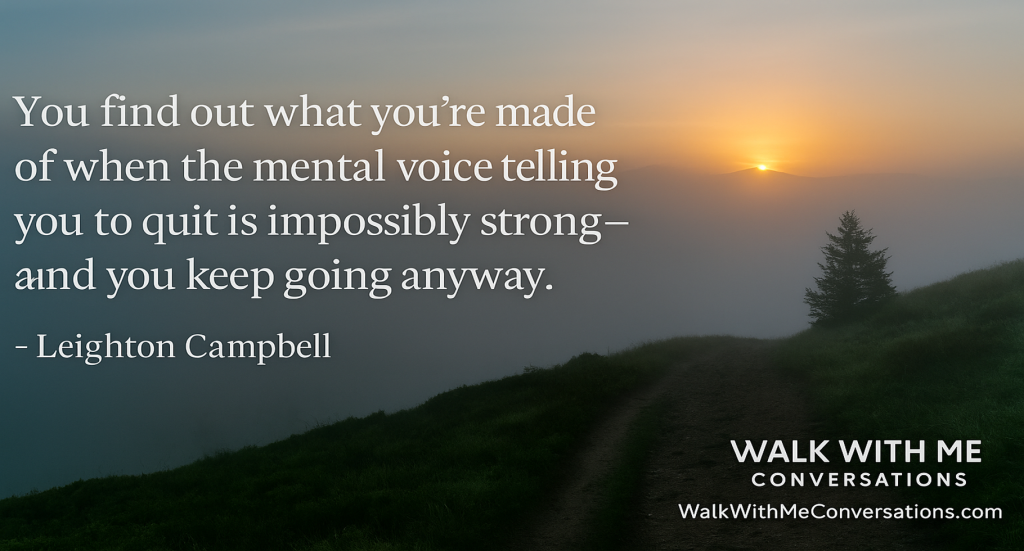
During college, he entered a summer sales program—door-to-door, commission-based, emotionally brutal. While his peers enjoyed carefree summers, he was out in the heat, far from home, facing slammed doors and silent judgments. He described how his internal monologue begged him to quit, how every “no” felt like a blow to the chest.
But then he said something that shifted my thinking:
“Learning to handle the no’s—and how many no’s you get—taught me that rejection isn’t personal. It’s practice.”
This wasn’t just a mindset shift. It was a strategy. Rejection became repetition. And repetition, he explained, eventually builds resilience. As someone with sales background, I couldn’t agree more.
In an age obsessed with optimization and speed, Leighton’s approach stands in sharp contrast. He isn’t interested in shortcuts. His story underscores the idea that persistence isn’t about chasing success—it’s about building muscle. Emotional muscle.
It caused me to reflect on the expectations we set for ourselves and others. Are we preparing ourselves for rejection, or avoiding it entirely? Are we raising children to tolerate discomfort—or to be defined by ease? If we remove all of the difficult challenges in life, will we eliminate our resilience?
What Leighton reminds us is that our internal architecture—how we interpret struggle—matters more than any external reward. If you can turn failure into feedback, and discomfort into direction, you are set up to withstand what life will throw at you.
In listening to his story, I was reminded that the real work of becoming who we are meant to be happens in those moments we’d rather skip. The door that slams, the silence that follows, the choice to keep going. That’s where character is forged.
As someone who walks with others through their own healing journeys, I’m always listening for stories that don’t just inspire—but recalibrate. Leighton’s equation doesn’t promise quick fixes. It offers a mirror, and a challenge:
Are you willing to turn “no” into your training ground?
Because resilience isn’t an accident. It’s a decision. One you make over and over—especially when no one is watching.